Interests • Functional Basis of Demographic Trade-offs • Seed Dispersal & Seedling Regeneration • Plant-Soil Feedbacks & Soil Microbiome • Biodiveristy & Change in Nebraska's Forests
Research: Interests
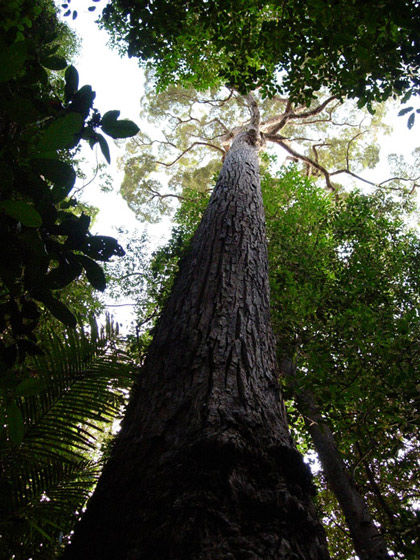
Community ecology is an area of ecology that quantifies natural patterns in the distribution, abundance, functional and phylogenetic properties, and interactions between populations of species in space and time and seeks to explain the dominant processes generating those patterns. Understanding how species can coexist together without causing each other to go locally extinct, for example through competition or predation, is important to explaining patterns of dominance and diversity in ecological communities.
Community ecology is at an important junction: There is increasing awareness that pattern and dynamics in local communities are influenced by ecological processes at larger spatial and temporal scales. However, fundamental processes that link populations and communities in space and time, such as dispersal, and the influence of evolutionary history on community structure remain poorly understood. Concurrently, the significance of interspecific differences has been questioned, pointing to the need to quantify the mechanistic links between functional trait variation and its demographic, and, ultimately, community-level consequences. I address these emerging issues in theoretically-driven empirical studies that use a combination of methods, including quantitative natural history, analysis of functional trait variation, experiments, statistical and mathematical models, applied comparative phylogenetics, and genomics.
My research tests fundamental hypotheses explaining patterns of species diversity, abundance, and distribution in ecological communities. Although my research interests are broad and have included a variety of taxa, I work primarily in tropical forests, where study important processes affecting on species diversity and distribution along environmental gradients: seed dispersal, plant-soil feedbacks, and the functional basis of demographic trade-offs.
If you are interested in studying ecology as a graduate or undergraduate student in my lab, please contact me and see the further information here and check out my google scholar profile for publications.